Kemp Center – Practical Courses and Expert Training

Whenever you ask someone what HR does, they will most likely say “Oh, they handle hiring and firing.” That would be like saying a chef just cuts up fruit and vegetables. While this is true, it doesn’t truly capture the magic of what HR does.
The outdated version would have you believe that HR only pushes and moves paperwork around, when someone is hired or when someone gets the boot. This makes the HR department in many companies undervalued. But the truth is HR doesn’t just deal with resumes and terminations. HR is involved in creating a culture where people want to work. Also, it helps with leadership development, innovation and strategic growth. Here are the 10 core functions that prove HR isn’t just important—it’s indispensable.
The Evolution of Human Resources: From Personnel to Strategic Partner
For decades the HR department was known for focusing on administrative tasks such as payroll, compliance and recordkeeping. While, these tasks are important they are often seen as back office and not core to the business strategy.
This perception has radically changed over the past few years. Anyone who works in HR today is part of leadership discussions, shaping everything from organizational culture to workforce planning and business transformation. HR is no longer just task oriented but a key element for strategic growth.
“Organizations that view HR as a strategic partner are 1.5 times more likely to report effective talent management and 1.3 times more likely to report better business performance.”
— SHRM, latest research shows
Now the difference between what was once traditional roles in HR and the modern HR strategies is significant. Now the difference between what was once traditional roles in HR and the modern HR strategies is significant.
Hard HR vs. Soft HR: Understanding the Two Pillars
Human resources operates in dual frame, hard and soft HR. Understanding both of these pillars is crucial to appreciate how HR supports both the operational backbone and the cultural heartbeat of a company.
Think about HR is like an orchestra. Hard HR sets the tempo, manages the sheet music and ensures that every single section is in sync. They help handle the structure, systems and compliance.
Whereas, soft HR is meant to inspire musicians, interprets the mood and brings the music to life. They will shape the culture, engagement, and growth. Combing the two brings harmony between business objectives and human potential.
Hard HR: The Administrative Foundation
Hard HR refers to the operational side, so this means the systems, processes, and policies that keep an organization running smoothly. They oversee compliance with labor laws, along with managing compensation and benefits. Hard HR focuses on handling employee data, and developing performance management systems.
They form the backbone of organizational efficiency which allows companies to scale, reduce risks and make decisions that are data driven and based on measurable outcomes. Some other responsibilities covered by hard HR include:
- payroll processing,
- attendance tracking,
- policy enforcement,
- and legal compliance.
It is analytics-driven, transactional, and extremely structured—essential for upholding order and reducing liabilities. Even the most people-focused strategies can fail in the absence of a strong administrative base.
Soft HR: The People-Focused Strategy
Soft HR is the human centric side, and is in direct contrast to hard HR. Soft HR helps with fostering a positive culture, building trust, and helping employees thrive. They tend to focus on long-term development as opposed to metrics. This includes:
- leadership training,
- employee engagement initiatives,
- internal communication strategies,
- DEI efforts,
- and talent development programs.
Soft HR doesn’t worry so much about enforcing rules, more so their goal is to nurture potential and growth. It’s where coaching, motivation, and emotional intelligence come into play. Honestly, it’s the strategic side of HR, as it drives innovation, retention, and performance. They are the ones that create a workplace where people feel valued and empowered to do their best work.

10 Essential Functions Every HR Department Handles
So, we have mentioned that the modern HR department handles more than just hiring and firing. They drive business success by blending data, strategy, and empathy into every stage of the employee experience. Let’s dive into 10 core functions that define an effective HR team.
Strategic Workforce Planning & Talent Acquisition
So, let’s say that you are part of a growing tech company that is preparing to launch it’s new product within 6 months. In order to this successfully they need to hire a full-stack developer, a product designer, and a customer success lead. Additionally, they need to be onboarded and aligned with the roadmap by Q3.
When you are part of the HR team, you won’t be just posting job ads. You will be partnering with leadership to anticipate needs, refine role profiles, and align the hiring timeline with business strategy.
In order to do this effectively, you will probably use tools like Applicant Tracking Systems (ATS) to manage candidate pipelines, automate communication, and ensure a smooth hiring process from first click to final offer.
According to SHRM, the average cost-per-hire is $4,700, up from $4,129 in 2019, and the average time-to-fill a role is 36‑42 days. The numbers can climb significantly depending on the industry you are hiring for. This is why efficient talent acquisition is so important, it will help you save time and money. Additionally, it will make sure that crucial roles are filled during those key growth periods.
The evolution of HR into a strategic partner represents one of the most significant workplace transformations of the past decades. As Harvard Business Review notes in their foundational research on HR transformation, HR should be defined not by what it does but by what it delivers.
Employee Onboarding & Integration
Alright, now that you have hired the right employee for the job it’s time for onboarding and integration. And I’m sorry to break it to you, but a quick orientation is not enough. A strong onboarding and integration process is the key driver to ensure long term engagement and success. If you have a weak onboarding process, you will likely see turnover among your staff.
Here is checklist that you can follow to create a successful onboarding routine for your new hires:
- Pre-boarding setup (tech access, paperwork, welcome kit)
- Warm welcome to the team / company (intro email, team meeting, office tour)
- Role clarity & goal setting (first‑week expectations, 30/60/90‑day plan)
- Assign a buddy or mentor for the first couple weeks (peer guidance, shadowing)
- Share information about company culture and values (company story, core values)
- Provide role specific training (where applicable) (tools, systems, processes)
- Regular check-ins (weekly first month, monthly next quarter)
- Support the new hire in integrating with your team (cross‑functional introductions, social events)
- Set up performance checkpoints (feedback loop, early reviews)
- Create an ongoing development blueprint (career path conversation)
So, I have seen companies approach onboarding in two different ways. At one firm, the new hire arrives the first day only to find that their laptop is missing and no one from the team is greeting them. This lead to the new hire feeling disengaged and frustrated. Needless to say, they ended up leaving that company very quickly. Another company took a different approach. When the new hire came in on their first day, the team had already set up the desk, assigned a mentor, and scheduled check-ins from day one. That new employee hit the ground running—and stayed.
The numbers back this up. According to comprehensive research from SHRM (Society for Human Resource Management):
- 69% of employees are more likely to stay for 3 years if they have a strong onboarding experience
- Companies with structured onboarding see 50% higher retention
- A whopping 82% boost in retention stems from excellent onboarding
These retention statistics further highlight the importance of a strong onboarding and how it sets the tone for long term employee loyalty.
Performance Management & Employee Development
A strong organization doesn’t just set goals; they ensure their teams have the guidance and support to exceed them. So, imagine this, an employee takes part of a mid-year performance review where the manager says “You’ve exceeded your Q1 targets—great work! Let’s outline a stretch goal and I’ll coach you weekly to make it happen.”
This isn’t a checkbox exercise—it’s a meaningful performance conversation that builds momentum and trust. According to a study done by SupplyGem, companies that spend money on employee training ee up to 24% higher profit margins and enjoy an average 4.5× return on every dollar invested. Not to mention that businesses that offer training also see 34% lower staff turnover.
Let’s explore some employee career development pathways, with the help of a chart:
Level | Focus Areas | Impact on Employee & Employer |
Entry → Mid | Skill training, clear KPIs, mentoring | Builds confidence, reduces early attrition |
Mid → Senior | Leadership workshops, stretch projects, feedback loops | Drives innovation and retention of top talent |
Senior → Lead/Manager | Coaching, strategic planning, 360° feedback | Prepares next-gen leaders and boosts succession readiness |
Creating pathways based on the career level and the area of focus will help the employee feel that they are invested in. This is a critical factor when it comes to employee retention. A study by Pop.work in 2023 found that higher employee engagement correlates with improved performance, specifically a 40% increase in employee engagement and a 26% improvement in performance. This highlights the positive impact of employee engagement on productivity and overall business outcomes.
So, it’s important for HR teams to pair performance reviews with targeted development programs to ensure an individual meets their potential. Also, so that they can help with overall organizational success.
Compensation & Benefits Administration
A successful HR team knows that compensation isn’t just about that paycheck or direct deposit every month. The real magic behind compensation is using it to help attract, retain and reward top talent. Also, it should stay compliant with your local labor laws.
When you work in HR, you will likely carry out salary benchmarking. This is the process in which you can compare your compensation and benefits packages to those of your competitors. This can be done for any specific industry, location and role. Many HR teams use tools such as PayScale, Mercer, or Radford to benchmark salaries.
Another key aspect that comes to compensation and benefits is managing employee benefits. Typically, employee benefits include health insurance, retirement plans, wellness programs, etc.
To make the process easier, HR teams work with brokers and platforms like Gusto or ADP. Navigating plan types, eligibility requirements, and contribution caps, however, frequently calls for in-depth familiarity with both federal regulations and systems.
Finally, HR teams need to make sure that everything is compliant with labor laws. Straying away from these laws can lead to expensive fines, lawsuits, and reputational damages. This is why most HR teams work closely with finance and legal to audit programs, track eligibility and process documents.
Employee Relations & Conflict Resolution
Now the true genius behind a good HR team is being able to manage employee relations. It’s not enough to just resolve problems, you want to build trust, protect company culture and ensure that everything is legal and ethical.
Don’t think of yourself as the referee, but you are the neutral facilitator so like Switzerland. You don’t take sides, but your goal is to solve the problem. Let’s look at a real world scenario that you may encounter:
Two individuals on a product team, both of whom were high performing, had been in constant friction. One person thought the other excluded them from key meetings, while the other felt the tension turned into micromanagement! When left unresolved, you can imagine how the tensions were influencing the collaboration and timelines! HR facilitated one-on-one interviews, examined the gaps, and led a mediation meeting that produced a common action plan—and saved both careers.
So, what can you do as someone working in HR?
Well, there are a few options that should work to help resolve this situation:
- Active listening. So, you want to validate everyone’s feelings and perspective.
- Reframing. Turn those accusations into observations, to diffuse anger and tension.
- Common-ground building. Turn the focus to shared goals, rather than focusing on past behaviors.
- Action oriented follow ups. Document agreed steps forward and schedule check-ins to see if there is improvement.
You can help not only end the conflict but help the two employees build a better working relationship. Confidentiality, empathy, and neutrality are key to making the process feel safe and productive. You also need to remember to resolve conflict constructively and stick with policy along with any laws that are in place.
Mastering conflict resolution takes practice and the right communication techniques. Our Communication Course teaches you the clear, compelling communication skills that turn tense situations into productive conversations.
Compliance & Legal Documentation
When you work in HR, compliance isn’t optional; it’s crucial to the mission. You need to ensure compliance of wages to workplace safety. As an HR professional you serve as the first line of defense for the company against any legal or regulatory missteps. Both can cost the company a fortune and ruin their reputation.
Payroll Processing & Time Management
So, HR and payroll go together hand in hand, like a peanut butter and jelly sandwich. While many people assume that payroll is a backend function it is a visible and sensitive aspect of every employee experience. When its done well it builds employee morale by building trust and confidence. However, any misstep or wrong doing and you can be sure that employee morale will deep and you may even see turnover.
Timely and accurate payroll is not just about paying someone, it’s about showing respect. Also, it’s abiding by the laws and regulations that take place in each country. A single miscalculation in hours, overtime, or tax withholding can lead to employee frustration, legal claims, or compliance fines. For hourly and shift-based workers especially, pay accuracy is a core trust metric.
Now, most modern HR teams use a time tracking system whether this be Rippling, ADP, Gusto for in office employees. Or it can be software such as Toggle or Clockify for remote based work. These systems offer the ability to track when someone clocks in or out. Also, you can track paid time off and sick leave. It will help you flag overtime and ensure compliance. Finally, many of these systems can be integrated with your payroll system.
Workplace Safety & Risk Management
So, workplace safety is not just a checklist that you can check off and be done with it. As an HR professional you will play a central role in ensuring the physical and emotional well being of the employees. So that they feel protected and supported while minimizing organizational risk.
If you work for the US, you will likely need to ensure that your employer follows the Occupational Safety and Health Administration (OSHA). This means that you must ensure your workplace is free of recognized hazards. Also, if applicable you need to provide the appropriate personal protective equipment.
Another situation that you will be required to handle as an HR professional is reporting incidents. So, accidents in the workplace do happen occasionally. So, whether it’s a slip-and-fall, ergonomic strain, or near miss—swift reporting is crucial. Typically, in these scenarios you need to provide immediate care for the affected employee. You will need to report the incident to leadership and of course complete and submit internal incident reports.
Finally, HR teams organize safety training programs. HR works alongside Operations, Facilities, and Legal in determining the necessary risk-based training in the workplace.
Risk-based training may comprise:
- OSHA compliance on an annual basis
- Fire safety drills and evacuation drills
- Ergonomics and injury prevention training
- Psychological safety training with DEI
Also, these trainings reduce injuries at work and foster a culture of accountability and trust. Strong safety programs in high-risk industries can cut workplace injuries by more than 50%, thereby reducing insurance costs significantly.
Company Culture & Employee Engagement
Now, I know what you are thinking, enough with this ‘company culture’ talk, but I urge you to hear me out. Company culture is this invisible force that shapes how employees feel, perform, and stay.
HR teams are the creators and gatekeepers of company culture. They use data to assess and boost employee engagement. HR relies on tools like focus groups, one-on-one interviews, and cultural audits to understand company culture. They may send out a questionnaire to gauge employee engagement and satisfaction.
A great way to boost company culture and increase employee engagement is via reward or recognition programs. These types of programs can take a on few forms such as:
- Using tools like Bonusly or Kudos for peer-to-peer shoutouts.
- You can also have monthly awards to celebrate core values in action
- Spot bonuses tied to outstanding contributions
- Also, consider doing team celebrations for milestones or project completions
When employees feel seen and appreciated, turnover decreases and productivity soars.
Strategic HR Analytics & Reporting
An HR team that has an edge usually bases their strategy on data and analytics. They turn those insights into smarter decisions and stronger business outcomes. Some key HR metrics that you will likely track include:
- Employee turnover
- Employee engagement
- Productivity levels
- Time-to-hire & cost-per-hire
- Absenteeism
- Training ROI
When you monitor these metrics and trends, you can pinpoint trends, anticipate challenges, and make course corrections.
Many HR teams use dashboards to visual data in real times. Some popular tools include BambooHR, Workday, or Visier. You gain interactive charts that show you employee turnover by department. Also, you will have heatmaps showing engagement scores over time. Additionally, these tools offer recruitment funnels that help highlight any bottlenecks. Finally, these dashboards can also alert you to policy compliance deadlines.
With analytics, HR can do more than just guess. They can use real data to make smart calls, like tweaking how they hire or personalizing programs to keep folks around. Say HR notices that a certain team’s losing people fast; they can jump in and fix things before the team’s spirit really tanks.
When HR puts analytics together with planning, it goes from just helping to actually pushing the whole business forward.
A Day in the Life: What HR Professionals Actually Do
Let’s take a snapshot look at what your day will look like as an HR professional, hour by hour, to give you a real idea of the role beyond stereotypes. After 10+ years in HR, here’s what a typical Tuesday actually looks like for me…
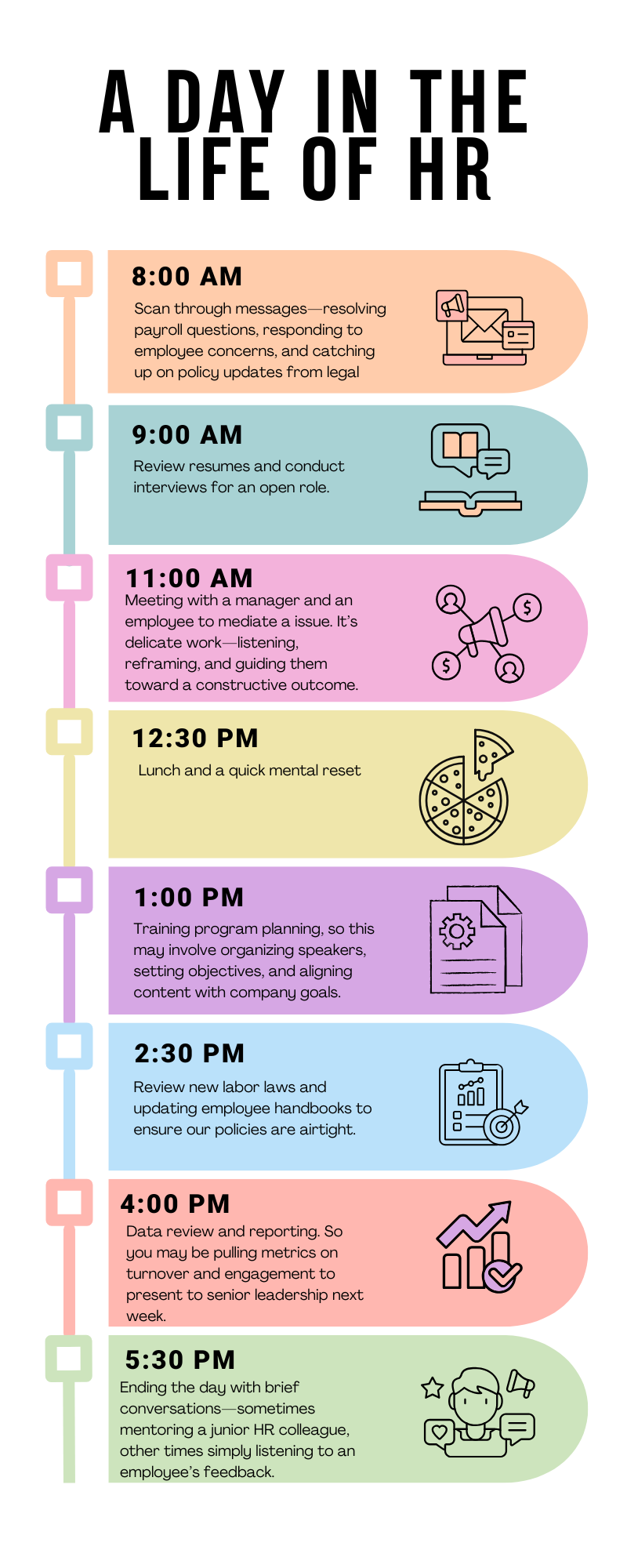
HR is rarely predictable, often challenging, and always deeply human. If you’re curious about stepping into this world, check out our guide on How to Find a Job in HR to get started.
Skills You Need to Succeed in Human Resources
If you want to be a successful and powerful HR professional, you need the perfect storm of skills to be effective in your job. You need the technical skills, the soft skills and the appropriate certifications to be on your way in your career. So, let’s take a look what it takes to thrive in this field.
Technical Skills
As an HR professional in today’s digitized world you need to flex your fluency in various software programs and regulatory frameworks.
Some key tools include:
- HRIS platforms like Workday, BambooHR, or ADP for managing employee data
- Payroll and benefits software to ensure that people receive their paycheck on time and in compliance with regulations
- Employment law knowledge. You need to stay audit ready and avoid legal troubles.
Soft Skills
A great HR professional will have excellent soft skills. You have to remember that HR is a people-facing role at its core. So here are some skills that you must have:
- Clear communication both written and oral. This comes in handy for conflict resolution along with policy work.
- Empathy
- Problem solving
- Adaptability
You will find yourself being the calm in midst of the chaos. These human centric skills will help you build trust across the organization.
Essential Certifications
The right credentials can not only boost your credibility but also your paycheck. So, this is always something worth considering when looking to become an HR professional. Industry certifications show employers that you’re serious and up to date. The most recognized include:
- PHR/SPHR (HRCI) for countries like the United States
- SHRM-CP/SCP most international organizations will recognize these certificates
- CIPD is needed for any HR job in the UK
- CEBS is mainly USA and Canada based
According to recent industry salary data, certified HR professionals earn up to 31% more than their non-certified peers. That’s a strong ROI for your time and effort.
Career Paths and Advancement Opportunities
Human Resources is a dynamic career; it’s not one singular role. You will have room to grow, specialize, and lead. So regardless of whether you are starting in HR or you are looking ahead, HR offers a range of roles across industries, functions, and seniority levels.
So here is what your career path may look like as an HR professional:
- HR Assistant / HR Coordinator. This is an entry level role; the salary range: $45,000–$58,000. You are focused on admin support, recruiting help, and onboarding logistics.
- HR Generalist / HR Specialist. In this role you can expect tasks such as employee relations, benefits, or compliance. A typical salary range is around $60,000–$75,000
- HR Manager / Business Partner. Here you will have more strategic responsibilities, team supervision, and cross-functional planning. In this role you can expect a salary of $80,000–$105,000.
- HR Director. You will lead multiple HR functions and help shape company culture and policies. Also, you can probably expect a salary of $110,000–$140,000.
- VP of HR / Chief Human Resources Officer (CHRO). This is an executive leadership role, where you will be reporting directly to the CEO. Also, you will be aligning HR with business needs. Salary range: $150,000–$250,000+
According to the Bureau of Labor Statistics, employment of HR managers is projected to grow 5% from 2022 to 2032—faster than the average for all occupations.
Now you may decide that you don’t want to go the route from assistant to Chief Human Resources Officer. And that’s okay, you can build an amazing career in a specialized area of HR. Some popular specializations within HR include:
- Recruitment & Talent Acquisition
- Compensation and benefits
- Learning & Development (L&D)
- HR Analytics & Operations
- Employee Experience & Culture
So regardless what your drive is, HR offers long-term career paths with real upward mobility and an increasing impact on the future of work.
Frequently Asked Questions About HR Careers
Do you need a degree to work in HR?
No, not always. Many entry level jobs don’t require a degree or experience. HR usually has people from a variety of diverse backgrounds. You can have relevant experience or certificates. But a degree can help you stand out, especially for mid-to-senior roles.
Is HR a good career for introverts?
Yes, as long as you are comfortable communicating. HR does have roles where you don’t have to be ‘on’ all the time. A good example is HR analytics, compensation, and compliance; they involve more behind-the-scenes work. Whereas employee retention or training will require more face time.
What’s the hardest part of working in HR?
This role is very emotionally complex. As an HR professional you will find yourself managing sensitive situations such as layoffs, conflict resolution and compliance investigations. You will need to balance empathy and fairness. Sometimes this role can be mentally demanding but it’s rewarding when done right.
How much can you earn in human resources?
Salaries vary widely based on location, experience, and specialization. Entry-level HR assistants earn around $45,000–$55,000, while HR directors and VPs can earn $120,000–$200,000+. Certified professionals consistently earn more than non-certified peers.
Is HR being replaced by technology?
No. But HR is rapidly evolving to take advantage of technology like ATS platforms, payroll software, and AI-based tools to automate administrative tasks. This helps HR professionals to focus on strategy, culture, and employee experience. The human side of HR is more critical than ever.
What industries have the best HR opportunities?
There are HR opportunities in most fields and industries. The most popular include tech, healthcare, finance, and manufacturing. You can work for a startup if you want to be an HR generalist, this will allow you to wear many hats. While, a role in a large corporation may seek specialists in the HR field.

Summary
If you think that HR is just awkward meeting and paperwork, think again. HR is the secret sauce behind every great workplace. HR professionals are part strategist, part therapist, part data wizard.
So if you want to get in on this, here’s the lowdown:
- The HR team is the heart of the company. It is responsible for shaping culture, finding top talent, and keeping things running smoothly.
- You need to be tech savvy, know about systems and laws, and finally have people skills that would be a therapist green with jealousy.
- Being certified is your golden ticket to more opportunities and more money.
HR has evolved from administrative support to strategic business partner, and this transformation isn’t slowing down. As organizations continue to recognize the value of skilled HR professionals, those who invest in developing complementary business skills will find themselves at the forefront of this exciting field.
For professionals looking to understand the broader business context that makes HR truly strategic, our Business Administration Course provides the valuable skills you need to succeed in today’s global marketplace.